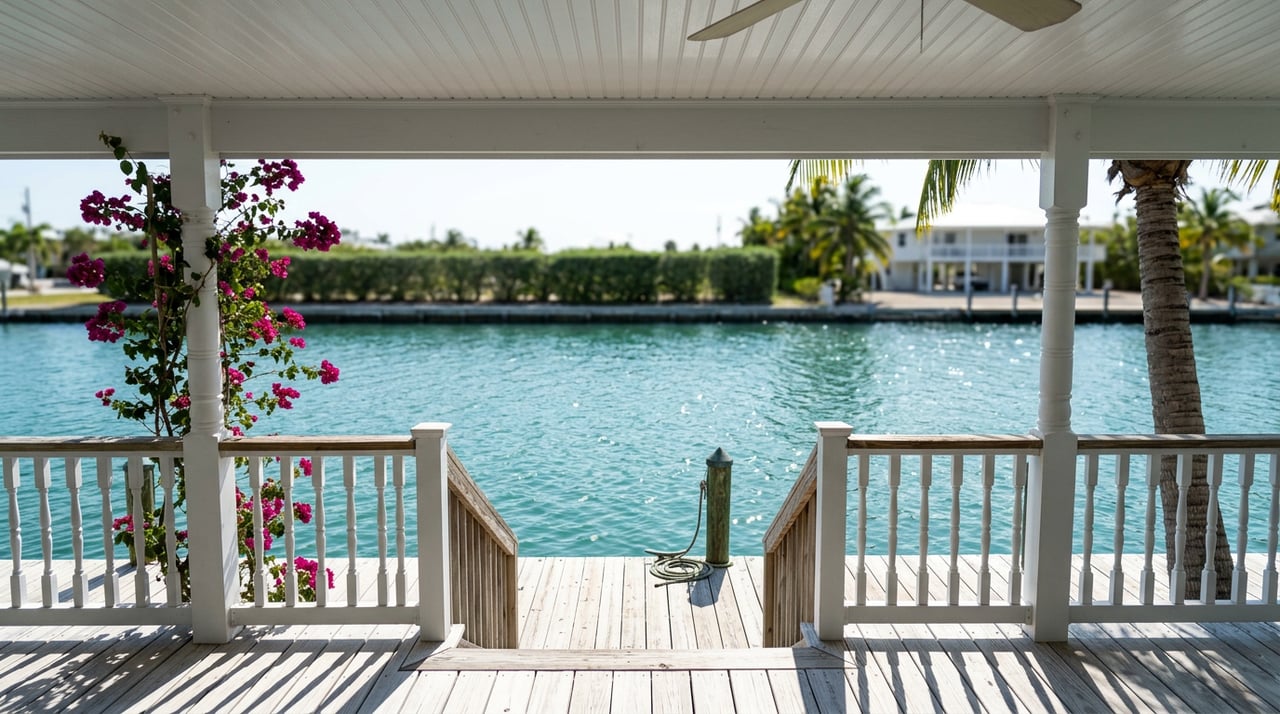
The Real Asset in a Vacant Upper Sugarloaf Key Lot Isn't the Dirt. It's the Permit.
September 24, 2026
September 24, 2026
Scroll through vacant land listings on Upper Sugarloaf Key long enough and a pattern shows up. A canal-front parcel with no-bridge ocean access, oversized at nearly 15,000 square feet, gets marketed this spring with one detail placed ahead of the water frontage: it already carries an active building permit for a 2,120-square-foot home. The permit isn't a footnote. It's the headline.
That ordering tells you something the price-per-square-foot comparisons never will. On this island, the gap between a vacant lot and a finished home isn't really about the cost of construction. It's about whether the county will ever let you build at all.
Every buildable lot in unincorporated Monroe County, including the ones scattered through Upper Sugarloaf Key's canal-front subdivisions, sits inside a system called the Rate of Growth Ordinance. ROGO doesn't zone land. It rations permits. The county can only issue so many building permits each year because state rules require Keys residents to be able to evacuate the island chain within a set window before a hurricane makes landfall, and every new rooftop adds a car to that evacuation.
A vacant, buildable lot on Upper Sugarloaf Key doesn't come with an automatic right to build. It comes with the right to apply. Applications are scored on a quarterly competitive point system, weighing things like flood zone tier, proximity to infrastructure, and environmental sensitivity, and only the top scorers in each quarter's pool receive an allocation. A lot without existing points or a permit already attached is, in practical terms, an entry in a lottery with a shrinking number of tickets.
Here's where the timing gets specific. Monroe County has been distributing its remaining pool of market-rate ROGO allocations at a rate of 62 per year, and that supply was set to run out in July 2026, according to Keys Weekly's reporting on last October's county commission session. That deadline has already come and gone as of this writing.
The county isn't simply letting the system expire. As of late 2025, commissioners were working two parallel fixes at once:
Both tracks needed sign-off from the Florida Department of Commerce before they could take effect, and the county planned to transmit its final language after the 2026 legislative session concluded in March. Whether that approval landed cleanly or is still tangled in review is the kind of detail that changes month to month, which is exactly the point. Commissioner David Rice put the frustration plainly at that same October meeting:
"The thing that bothers me is we're being forced to operate in an environment, not without rules, but they're vague and undefined, which is about the same as having no rules."
If a county commissioner is describing the rules as functionally undefined, a buyer relying on an online listing description of "buildable" should treat that word as a starting point for questions, not a settled fact.
The more surprising piece of this story, and the part that doesn't show up in any generic ROGO explainer, is who's pushing back against adding more allocations to that pool.
The Sugarloaf Shores Property Owners Association and the Upper Sugarloaf Residents Association, two civic groups that represent the exact streets where these vacant lots sit, joined fourteen other Keys organizations in a formal letter urging the county to slow down before accepting any new ROGO allocations. Their objection wasn't abstract. They specifically challenged the county's count of "buildable" vacant lots as inflated, and they raised concerns that a separate $1 billion estimate of the county's legal exposure from lawsuits by lot owners was being used to pressure the process toward accepting more permits than the infrastructure or environment could reasonably absorb.
This matters for anyone evaluating land here because it means the scarcity isn't just a bureaucratic accident waiting to be fixed. It has organized local support behind keeping it in place. A buyer who assumes the permit shortage is a temporary glitch that state legislators will smooth over is underestimating how many of the neighborhood's own residents are actively arguing for the opposite outcome.
None of this touches homes that are already built. An existing structure on Upper Sugarloaf Key doesn't need a new ROGO allocation to be bought, sold, or renovated within its existing footprint. The allocation system governs new construction on vacant land, which is precisely why average asking prices across active Sugarloaf Key listings on Berkshire Hathaway HomeServices Keys Real Estate's own feed sit north of $3.4 million, with average square footage running to 2,191 against a county average of 1,797. That premium reflects finished, permit-free product in a place where the alternative carries real uncertainty.
If you're the buyer weighing a vacant lot against a comparable built home, the questions that actually matter aren't about lot size or water depth. They're about the permit's status:
A seller who can answer all four with documentation is offering something meaningfully different from a seller who can't, even if the two lots look identical on a map.
Does this affect homes that are already built on Upper Sugarloaf Key? No. ROGO governs new construction permits on vacant land. An existing home changing ownership doesn't need a new allocation.
What if the lot I'm considering already has ROGO points or an active permit? That changes the calculation significantly, since the competitive scoring and quarterly waiting period have already been resolved. Ask for documentation of the permit's issue date and status rather than relying on the listing description alone.
Could the allocation pool grow again after 2026 or 2027? It's possible. Senate Bill 180 authorizes up to 900 new allocations statewide, and the county has a path to absorb some of them. But that path required state approval that was still working through review as of early 2026, and the neighborhood's own property owner associations are on record opposing an expansion. Anyone counting on more permits becoming available should verify current status with Monroe County Planning and Environmental Resources before making an offer contingent on it.
If you're weighing a vacant parcel against a finished home on Upper Sugarloaf Key, or trying to figure out what a specific lot's ROGO status actually is before you write an offer, that's exactly the kind of question worth a conversation before you're under contract. Sherri Blasingame works this market from a desk on Duval Street with the local relationships and MLS history to help you read a listing correctly the first time. Let's Connect.
Stay up to date on the latest real estate trends.


I am committed to guiding you every step of the way—whether you're buying a home, selling a property, or securing a mortgage. Whatever your needs, I've got you covered.
Sherri Blasingame
336 Duval St Key West, Florida 33040